

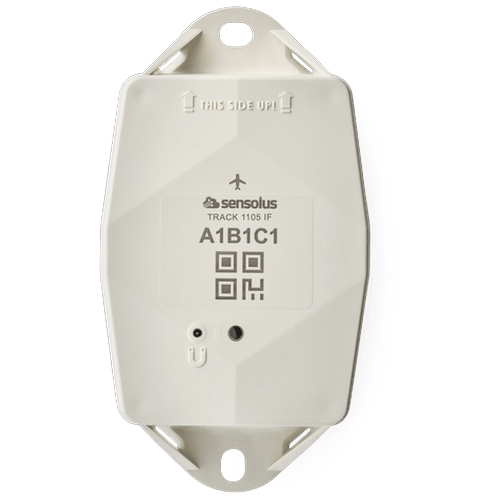
How TRACK 1105 IF works
The tracker uses an in-flight detection algorithm that automatically detects takeoff. On detection, it auto-disables all radio transmissions for the duration of the flight and powers radio back on after landing. Aviation-safe hardware design:- Battery: 5200 mAh + hybrid capacitor, lithium content under 2 g — below IATA/ICAO air transport threshold
- Casing: dedicated pressure monitoring sensor with 2 vent holes
Certifications
- DO-160G — aviation environmental test certification (vibration, altitude, temperature, EMC for airborne hardware). This is the legal minimum for any electronic device on a commercial aircraft.
- IATA approval — a recognized industry framework that helps streamline the path toward carrier acceptance. See the IATA ONE Source listing.
-
Airline-specific acceptance — on top of IATA, individual airlines may require their own approval. Currently approved by:
- AeroLogic
- Air Canada
- American Airlines
- Avianca Cargo
- Challenge Group
- FedEx Cargo
- Icelandair Cargo
- Korean Air
- Lufthansa Cargo
- Qatar Airways
- TAP Air Cargo
TRACK 1105 IF: /docs/pdf_authoring/images/sensolus-logo-white.svg TRACK 1105 IF GNSS/Wi-Fi/BLE - NB-IoT/LTE-M The rugged low-power tracker with long battery life with NB-IoT and LTE-M connectivity and guaranteed data recovery. The tracker provides general localization, zone and high precision. The tracker comes with an onboard temperature sensor and shock detection. Compatible with multiple external environmental sensors. The tracker firmware can be upgraded over the air. This tracker is DO-160 certified. GNSS Wi-Fi scanning Bluetooth geobeacon for zone precision NB-IoT LTE-M In flight certified Extended connectivity plan Data recovery IP65 & IP38 in progress IK 09 in progress Flame retardant TRACK 1105 IF 130×72×36 mm 212g (7.6 oz) Connectivity NB-IoT / LTE-M Energy efficient transceiver Internal omnidirectional antenna Bi-directional communication Data recovery OTA firmware upgrade (NB-IoT/LTE-M) Bluetooth Low Energy (BLE) Bluetooth Low Energy 5.0 Connectivity plan TRACK 1105 IF has the extended connectivity plan. Geolocalization GNSS Multi GNSS constellation chipset (GPS+GALILEO) BLE Sensolus proximity beacon detection Detectable by zone anchors Wi-Fi scanning Wi-Fi based geolocalization Wi-Fi 2.4 GHz Sensing Internal Activity monitoring Orientation monitoring Virtual tamper detection Temperature monitoring range: -20°C till 60°C (-4°F to 140°F) typical accuracy: +/- 0.25°C (+/- 0.45°F) worst case accuracy: +/- 1°C (+/- 1.8°F) Configurable shock detection Environmental BLE sensors Temperature & humidity Other BLE sensors can be requested Mechanics & Design Antennas All antennas are internal Water & dust resistance IP65 & IP68 Size 130x72x36 mm\n(5⅛ x 2⁵³⁄₆₄ x 1²⁷⁄₆₄ in) Impact resistance IK09 in progress Weight 205 gram (7.23 oz) Drop shock and vibration EN 60068 Color White Operating temperature -20°C to 60°C\n(-4°F to 140°F)* The specifics regarding operational temperature are contingent upon the application, installation circumstances, and environmental factors such as sunlight exposure. For further information, please reach out to Sensolus. Battery life can be affected when devices function for extended periods at the extremes of this range. Casing Shell: PBT/PC 29 TM-Z2 FR UV LS Flame retardant UV-stabilized Battery Standard 3 cell User replaceable battery pack (Li-SoCl2) 5200mAh + hybrid capacitor 1.44 gram (0.0507 oz) lithium, 2 cells of 0.72 gram (0.0253 oz) Compliant with 49 CFR 172.102 Special Provision 388 Certifications Regulatory In progress Bluetooth 5.0 Declaration ID in progress DO-160 Section 21 category H EASA AMC1 CAT.GEN.MPA.140 (d)(3)(ii)(B) Battery certifications UN 38.3 UL 1642 User Interaction Device activation Magnetic activation LED feedback Green & red LED feedback on the device Synchronize remote settings Instant: Magnet activation Periodic: No user interaction needed Management Services Diagnostics Battery lifetime prediction Detailed energy consumption Geolocation diagnostics Installation Communication quality Management OTA firmware updates over NB-IoT/LTE-M and BLE Remote configuration Tracker usage profiles External environmental sensors Application services Localization Journeys Activity Utilization Temperature detection Connectable with environmental sensors Tilt detection Shock detection Firmware configuration Communication service Data recovery strategy Communication conditions Smart switching between LTE-M and NB-IoT Location service Motion based,context based, periodic or scheduled Configurable update rate and journey detection Priority sequence (GNSS, Wi-Fi scanning , Bluetooth geobeacon) GNSS fix parameters Indoor detection algo Wi-Fi scan strategy BLE scan strategy General configuration Rule engine configuration Diagnostic levels Boot methods Accurate time synchronization Orientation service Orientation detection parameters Environmental sensing Polling and aggregation strategy Alerts Edge processing parameters Activity service Activity detection parameters Tamper service Virtual tamper algo configuration Shock detection Shock algo detection parameters In flight detection (T-PED tolerant aircraft) AMC1 CAT.GEN.MPA.140 (d)(3)(ii)(A)(a) & (d)(3)(ii)(A)(b) AC91.21-1D chapter 10 Security Device unique encryption keys End to end payload encryption Chacha 20 AES encrypted firmware Firmware upgrade allows only signed firmware images Note: Use of our tracking solution with third-party shipping, courier, and logistics services might be subject to those providers' applicable terms and conditions. Users are responsible for reviewing and complying with all relevant third-party terms. Sensolus makes no representations regarding and assumes no liability for third-party terms or services, nor for any user non-compliance with third-party terms. *The specifics regarding operational temperature are contingent upon the application, installation circumstances, and environmental factors such as sunlight exposure. Battery life can be affected when devices function for extended periods at the extremes of this range.Installation and activation manual TRACK 1105 IF: Mounting the tracker Guidelines how to mount the tracker can be found here. Tracker activation Activation of the trackers is preferably done with clear skies, and not inside (e.g. factory or warehouse). Trackers are not activated when delivered to your premises. Their subscription in the platform will start within six months of purchase. Activation troubleshooting Activating a tracker that communicates over the NB-IoT or LTE-M network can sometimes come with a delay. With a delay we mean that the online status doesn't appear within 5 minutes after holding the magnet to the tracker. This is mostly due to conditions on the network operator site. If the activation wasn't successful after 5 minutes the tracker will try again to activate again after waiting 24 hours. This long period of time is often an obstacle to start installing trackers to assets and makes the timing of the installation of the trackers cumbersome as it is important to only install trackers when they appeared as online on the platform. To overcome to 24 hours waiting time, you can do the following: If after 5 minutes of waiting and the status didn't change yet to “online” hold the magnet again for 5 seconds on top of the tracker to enforce a new attempt for activation. Keep trying every 5 minutes until the Online status appears. Installation advice Troubleshooting 1. Put the magnet on the tracker for less than 5 seconds 2. The possible LED feedback options are: Force new configuration download on the tracker Regulatory Information Federal Communication Commission Interference Statement This device complies with Part 15 of the FCC Rules. Operation is subject to the following two conditions: 1. This device may not cause harmful interference, and 2. This device must accept any interference received, including interference that may cause undesired operation. This equipment has been tested and found to comply with the limits for a Class B digital device, pursuant to Part 15 of the FCC Rules. These limits are designed to provide reasonable protection against harmful interference in a residential installation. This equipment generates, uses and can radiate radio frequency energy and, if not installed and used in accordance with the instructions, may cause harmful interference to radio communications. However, there is no guarantee that interference will not occur in a particular installation. If this equipment does cause harmful interference to radio or television reception, which can be determined by turning the equipment off and on, the user is encouraged to try to correct the interference by one of the following measures: - Reorient or relocate the receiving antenna. - Increase the separation between the equipment and receiver. - Connect the equipment into an outlet on a circuit different from that to which the receiver is connected. - Consult the dealer or an experienced radio/TV technician for help. FCC Caution: Any changes or modifications not expressly approved by the party responsible for compliance could void the user's authority to operate this equipment. This transmitter must not be co-located or operating in conjunction with any other antenna or transmitter. Radiation Exposure Statement: This equipment complies with FCC radiation exposure limits set forth for an uncontrolled environment. This equipment should be installed and operated with minimum distance 20cm between the radiator & your body. This equipment is not suitable for use in locations where children are likely to be present. Industry Canada Statement This device complies with ISED's licence-exempt RSSs. Operation is subject to the following two conditions: This device may not cause harmful interference, and This device must accept any interference received, including interference that may cause undesired operation. Under Industry Canada regulations, this radio transmitter may only operate using an antenna of a type and maximum (or lesser) gain approved for the transmitter by Industry Canada. To reduce potential radio interference to other users, the antenna type and its gain should be chosen so that the equivalent isotropically radiated power (e.i.r.p.) is not more than that necessary for successful communication. RF Exposure Requirements: This equipment complies with Canada radiation exposure limits set forth for an uncontrolled environment. This equipment should be installed and operated with minimum distance 20cm between the radiator and your body. Le présent appareil est conforme aux CNR d' ISED applicables aux appareils radio exempts de licence. L'exploitation est autorisée aux deux conditions suivantes: 1. le dispositif ne doit pas produire de brouillage préjudiciable, et 2. ce dispositif doit accepter tout brouillage reçu, y compris un brouillage susceptible de provoquer un fonctionnement indésirable. Conformément à la réglementation d'Industrie Canada, le présent émetteur radio peut fonctionner avec une antenne d'un type et d'un gain maximal (ou inférieur) approuvé pour l'émetteur par Industrie Canada. Dans le but de réduire les risques de brouillage radio électrique à l'intention des autres utilisateurs, il faut choisir le type d'antenne et son gain de sorte que la puissance isotrope rayonnée équivalente (p.i.r.e.) ne dépasse pas l'intensité nécessaire à l'établissement d'une communication satisfaisante. Déclaration d'exposition aux radiations: Cet équipement est conforme aux limites d'exposition aux rayonnements du Canada établies pour un environnement non contrôlé. Cet équipement doit être installé et utilisé avec un minimum de 20 cm de distance entre la source de rayonnement et votre corps. Note: Use of our tracking solution with third-party shipping, courier, and logistics services might be subject to those providers' applicable terms and conditions. Users are responsible for reviewing and complying with all relevant third-party terms. Sensolus makes no representations regarding and assumes no liability for third-party terms or services, nor for any user non-compliance with third-party terms. Safety advice – device subjected to strong mechanical impact Risk of delayed battery failure and chemical hazard If a device has been hit, crushed, or struck by a heavy object (for example a forklift, container, pallet, or falling load), the internal components and battery may be damaged even if no external damage is visible. Such damage can result in delayed overheating, leakage, or failure. If a device has been subjected to a strong mechanical impact, the following mandatory safety actions must be taken: Action Details :— :------- :-------- 1 Do not touch the device Do not move, lift, open, shake, or inspect the device immediately after the impact. Internal damage may cause delayed reactions. 2 Keep a minimum safety distance Maintain a clear distance of at least 5 meters from the device. Keep all personnel away during this period. 3 Wait at least 10 minutes The device must remain untouched and undisturbed for a minimum of 10 minutes following the impact. This waiting time allows potential delayed thermal or chemical reactions to become evident. 4 Observe from a safe distance Watch for warning signs: smoke, vapor, or unusual odor; heat generation; fluid leakage; hissing, cracking, or popping noises. 5 After the waiting period If any abnormal condition is observed, isolate the area immediately and notify responsible safety or supervisory personnel. The device must be quarantined and handled according to battery safety and disposal procedures. The device must not be used. A device may appear undamaged and still be unsafe. Normal operation after impact does NOT mean the device is safe. Failure to follow this safety advice may result in serious injury, fire, or chemical exposure. sensolus-internal ./images/Activation_track_1101_step_1.png Hold magnet on tracker Hold a magnet for about 5 seconds on top of the logo on the asset tracker. ./images/Activation_track_1101_step_2.png Red LED indicator You will first see a red LED. Do not remove the magnet yet. ./images/Activation_track_1101_step_3.png Green LED blinking When the green LED is blinking you can remove the magnet. Your tracker is ready for use. Avoid metal blocking Avoid blocking the tracker's view with metal or carbonfibre walls. They weaken or block the radiofrequency signals. Mount high Place the tracker as high as possible on the asset to ensure good network coverage. Clean surface Make sure the mounting surface is flat and clean, for a strong and durable bond. Avoid shocks Do not install the tracker on parts that receive frequent shocks or vibrations. Vertical mounting Install the tracker vertically, with the logo facing up. Protected location If your asset is handled in a rough environment, you can place the tracker in a protected location, but never with metal or carbonfibre above the tracker. Clear view Make sure the tracker has a clear view on the sky. Avoid water Avoid placing the tracker in a place that can collect water. Not upside down If you can't install vertically, do not mount the tracker upside down. Thermal insulation Place thermal insulation material, such as wood or plastic, between the tracker and the metal asset if the asset produces heat — for example, engines. Red LED Red LED: Tracker is not activated Green LED Green LED: Tracker is activated and working properly No LED No LED: tracker is not functioning (probably dead battery -> contact support) Red LED blinking Red LED is blinking: Tracker is busy ./images/FORCE_NEW_CONFIG_STEP_1.png Hold magnet Hold a magnet for about 5 seconds on top of the logo on the asset tracker. You will see a green LED. ./images/FORCE_NEW_CONFIG_STEP_2.png Red and green LED You will see a red and green LED. Now remove the magnet. ./images/FORCE_NEW_CONFIG_STEP_3.png Green LED blinking Green LED is blinking for minimum 30 seconds. Your tracker is checking for new configurations. ./images/FORCE_NEW_CONFIG_STEP_4.png Red LED - No new config You see a red LED: No new configuration received. ./images/FORCE_NEW_CONFIG_STEP_5.png Green LED - New config You see a green LED: New configuration setting received. Installation and activation manual TRACK 1105 IFSensolus drill hole template: 115 mm Drilling hole patterns for TRACK 1000 1001 1040 1100 Do not scale this drawing! Print on A4 paper